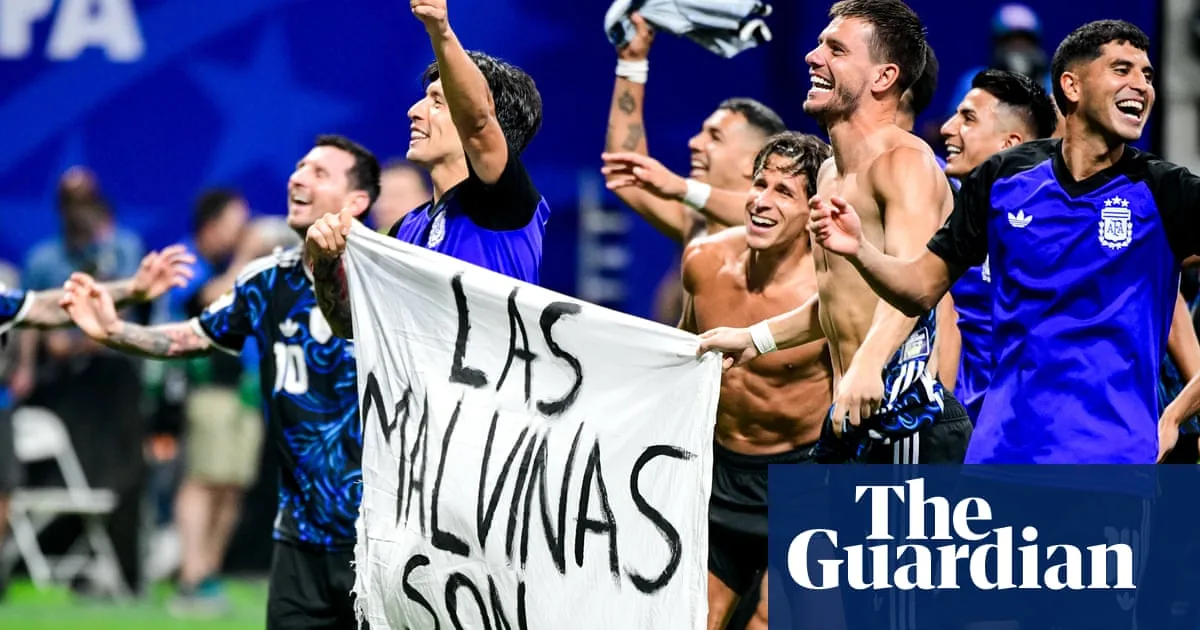

Football’s governing body, Fifa, is currently evaluating match reports following an incident where Argentina players displayed a banner referencing the Falkland Islands after their World Cup semi-final victory against England. The banner, which read “Las Malvinas son Argentinas” (The Falklands are Argentine), was shown after Argentina secured a 2-1 win in Atlanta, advancing to the final against Spain.
A spokesperson for Fifa confirmed that its independent disciplinary committee is assessing the reports and relevant circumstances to determine potential next steps, adhering to the Fifa disciplinary code. This procedure is standard for such incidents.
Political Statements in Sport
The display of the banner has reignited discussions about political statements in sports. The Falkland Islands, a British overseas territory in the south-west Atlantic Ocean, remain a point of contention regarding sovereignty between the UK and Argentina. A conflict over the territory occurred in 1982, lasting 74 days and resulting in significant casualties on both sides.
The government of the Falkland Islands expressed disappointment over the banner, stating that they hope Fifa will “sanction all behaviour of this nature in line with its own rules.” They also emphasised a desire to keep politics separate from sport. Similarly, the UK government reiterated its stance that the Falkland Islands are British, with a spokesperson for the prime minister stating, “Our commitment to the Falklands will never waver.”
Argentina‘s President Javier Milei reportedly described the players’ action as “understandable” and “valid” but also clarified that “the things that happen on the pitch are not part of diplomacy.” He affirmed that the Malvinas are Argentine and that their recovery would be pursued through diplomatic channels.
This is not the first instance of Argentina‘s football association facing scrutiny for similar actions. In 2014, the association was fined for displaying a banner with the same message before a friendly match against Slovenia. At that time, Fifa deemed the gesture a breach of rules concerning political action and team misconduct.
Several political figures in the UK have called for Fifa to investigate the incident. Peter Kyle, the business and trade secretary, stressed the importance of keeping politics out of the World Cup and urged a thorough investigation by Fifa. Kemi Badenoch, leader of the Conservative Party, echoed these sentiments, advocating for a Fifa investigation.
The leader of the Liberal Democrats, Ed Davey, has called for the Argentina players involved in holding the banner to be suspended for the upcoming final against Spain. He cited a precedent where Spain players Alvaro Morata and Rodri received a one-game ban from Uefa for chanting “Gibraltar is Spanish” during Euro 2024 celebrations.
Another precedent involves South Korea midfielder Park Jong-woo, who was charged by Fifa and subsequently received a two-match suspension after holding a sign that read “Dokdo is our territory” during the 2012 Olympic Games bronze medal match. This incident concerned a sovereignty dispute over a group of inlets administered by South Korea but claimed by Japan.
The semi-final match itself was described as occasionally fractious. England‘s Anthony Gordon opened the scoring, but Enzo Fernandez equalised, and Lautaro Martinez secured the win for Argentina in injury time. This victory adds another chapter to the intense World Cup rivalry between the two nations, which includes the notable “Hand of God” goal by Diego Maradona in the 1986 tournament.
Before the semi-final, Argentina manager Lionel Scaloni had stated his intention not to mix football and politics, acknowledging the 1982 conflict as a “very sad period in our history.”
The Falkland Islands held a referendum in 2013, where 1,513 out of 1,517 votes cast were in favour of remaining a UK overseas territory.
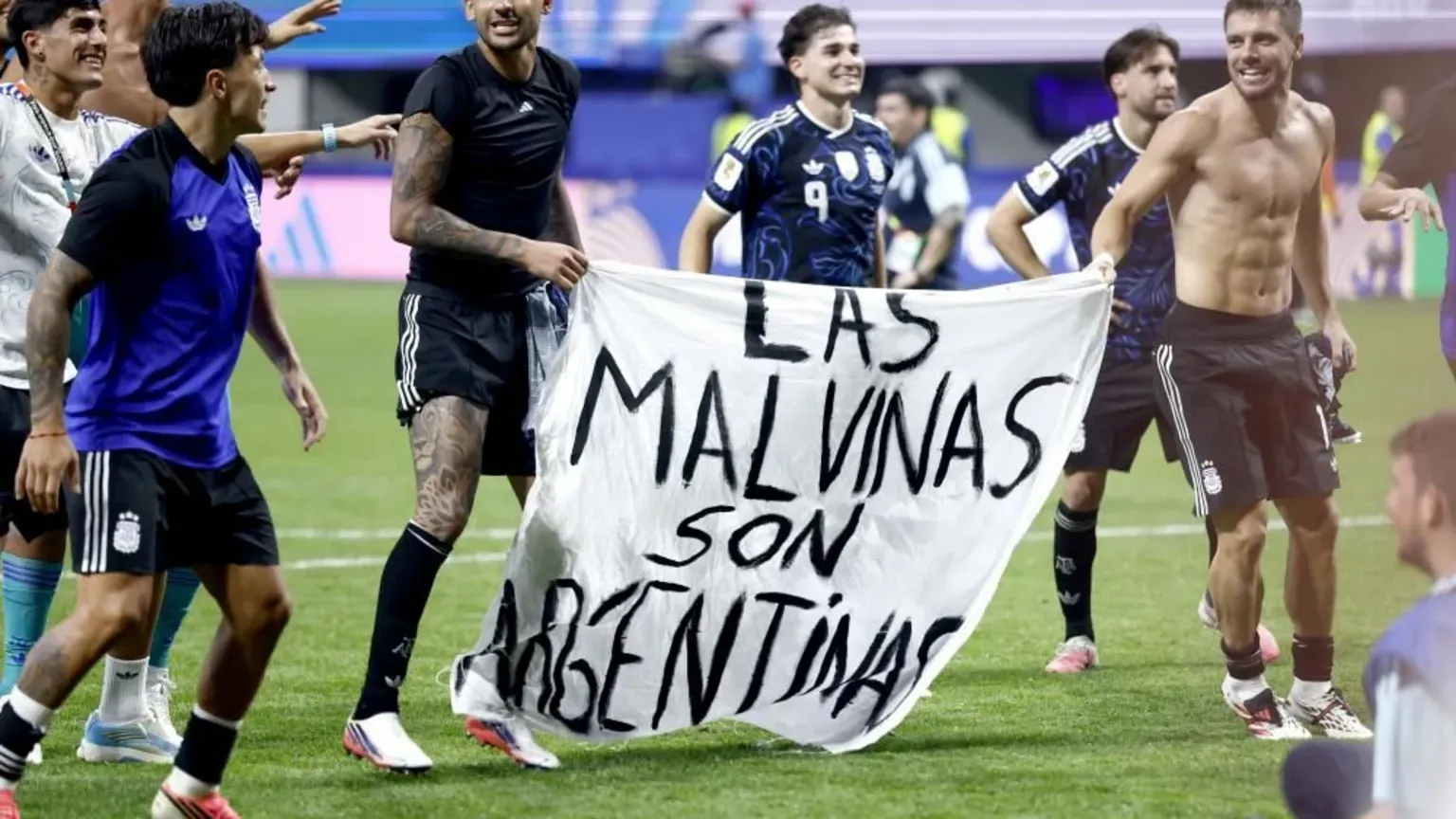
Reactions and Potential Consequences
The incident has drawn strong reactions from various quarters. Liberal Democrat MP Al Pinkerton condemned the scenes in Atlanta, stating that football was used to challenge the democratic right of Falkland Islanders to self-determination. Foreign Office Minister Stephen Doughty, responding in the House of Commons, expressed that it was a “real shame that people couldn’t focus on the football” and reaffirmed the UK‘s unwavering stance on the sovereignty of the Falkland Islands.
Argentina vice-president Victoria Villarruel posted on social media following the victory, stating that “it wasn’t just another match” and asserting that “The Falklands are Argentine.” She also mentioned that while bringing banners to the stadium might have been restricted, the sentiment is deeply ingrained.
The players’ actions follow previous instances where Argentina players chanted about the Falklands and celebrated their 3-2 win over Egypt in the round of 16 by referencing Maradona and Lionel Messi.
While there is no prospect of Argentina being removed from the final, Fifa‘s disciplinary committee will continue its assessment of the match reports and relevant circumstances to determine any further actions based on the Fifa disciplinary code.
Read Also
- Bellingham confronts Argentina players after semifinal loss
- England manager Thomas Tuchel to remain until Euro 2028 despite World Cup semi-final loss
- Atlanta: Bellingham in altercation after England's World Cup semi-final loss to Argentina
- Argentina defenders respond to Gary Neville's 'stupid' comments after England victory
Source: bbc.com

George Hartwell is the Senior Football Correspondent at News-GB.org, covering the Premier League, the EFL and the England national side with twelve years of reporting experience. He reported on West Country football before national coverage. He holds a degree in Sports Journalism from the University of the West of England and completed an NCTJ diploma. Based in Bristol, he watches grassroots football and writes a tactics column. “Tactics tell you more than any scoreline.”