
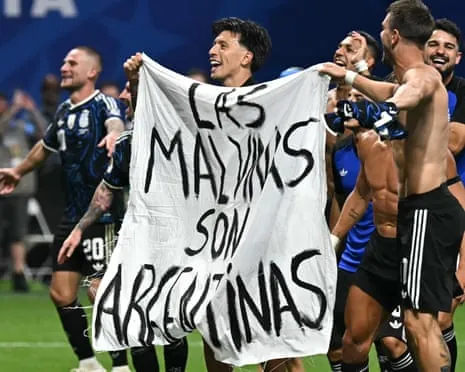
Following their World Cup semi-final victory against England, Argentina players displayed a banner referencing the 1982 Falklands War. The banner, which read “Las Malvinas son Argentinas,” was held up by players Lisandro Martínez and Giovani Lo Celso after their win in Atlanta.
The match saw Argentina come from behind, scoring twice in quick succession after being 1-0 down with five minutes remaining. This secured their place in a second consecutive World Cup final, where they are scheduled to face Spain in New Jersey.
Political Tensions and Sporting Context
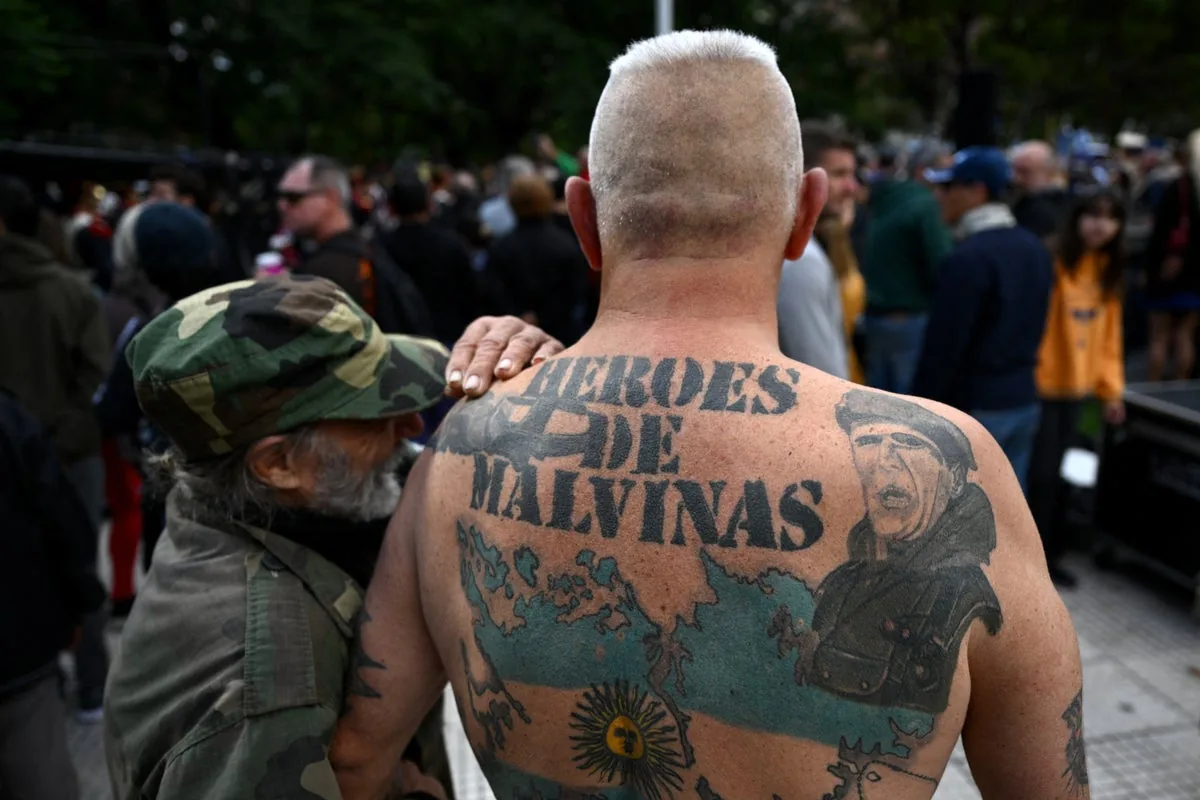
The display of the banner highlights ongoing political tensions between Argentina and Great Britain concerning the territory, known as the Falkland Islands in Britain and Islas Malvinas in Argentina. The dispute led to a 74-day conflict 44 years ago, which resulted in the deaths of over 900 people, including 649 Argentinians and 255 Britons.
Prior to the semi-final, Argentina‘s vice-president, Victoria Villarruel, made comments on social media platform X, referring to England as “usurping pirates” and “invaders.” She stated that the match was “not just another match” and that against the English, “it’s always something more.” Her post also invoked “the Malvinas, it’s Diego, it’s Leo’s last one,” and spoke of “putting the brakes on the invaders.”
Despite these remarks, Argentina coach Lionel Scaloni had attempted to distance the sporting event from political matters. In his pre-match press conference, Scaloni emphasised that mixing sport and politics would be “madness,” stating, “It’s a football match; I can’t mix things up, out of respect for what happened so many years ago.” He described the conflict as a “very sad time in our history” and urged that while people remember history, the football match itself should be kept separate.
Midfielder Rodrigo De Paul echoed a similar sentiment, acknowledging the historical significance but stressing the primary goal of winning the match. He noted, “We sing songs about our Malvinas heroes, mainly to remember them, but we have to understand that it’s a football match and that the Malvinas have to be discussed elsewhere.”
Security Measures and FIFA Regulations
The historical animosity between the two nations prompted discussions regarding security ahead of the match. A meeting involving the FBI, Fifa, and local police addressed potential fan escalations. Atlanta deployed additional personnel for the semi-final to ensure safety and security.
Argentina’s security minister, Alejandra Monteoliva, confirmed that enhanced security had been discussed at a meeting in the US. She stated that 1,600 officers would be present and that the entry of items with provocative messages, whether political or racial, was prohibited. This measure aligns with Fifa’s stadium code of conduct, which bans “banners, flags, flyers, apparel and other paraphernalia that are of a political, offensive, and/or discriminatory nature” inside stadiums.
The appearance of the banner after the match was not the first instance of political messaging during the World Cup. Previously, Iranian Americans displayed pre-revolutionary flags as a form of protest against the Tehran government during matches involving Iran in Los Angeles, which proceeded without incident.
Following their quarter-final victory against Switzerland, some Argentina players were heard chanting, “For the Malvinas, for Diego [Maradona] and for Leo [Messi]’s last one,” indicating the deep-seated connection many Argentinians feel towards the issue.
The banner display occurred after Argentina secured their place in the final, set to take place in New Jersey on Sunday.

Read Also
- Saliba limps off as France's World Cup hopes end against Spain
- England's World Cup semi-final hopes end in defeat to Argentina
- Stockport coroner rules Nobby Stiles' death linked to brain condition from heading footballs
- England manager Thomas Tuchel accepts responsibility for tactical decisions after semi-final defeat
Source: theguardian.com

As News-GB.org's Sports Reporter, Eleanor Vance reports on tennis, cricket and athletics for readers across the country. She built her name on long-form athlete profiles. She holds a degree in Sport and Media from the University of Bath and completed an NCTJ diploma. Eleanor lives in Bath, where she swims competitively and follows British athletics. “A profile is only as good as the questions behind it.”